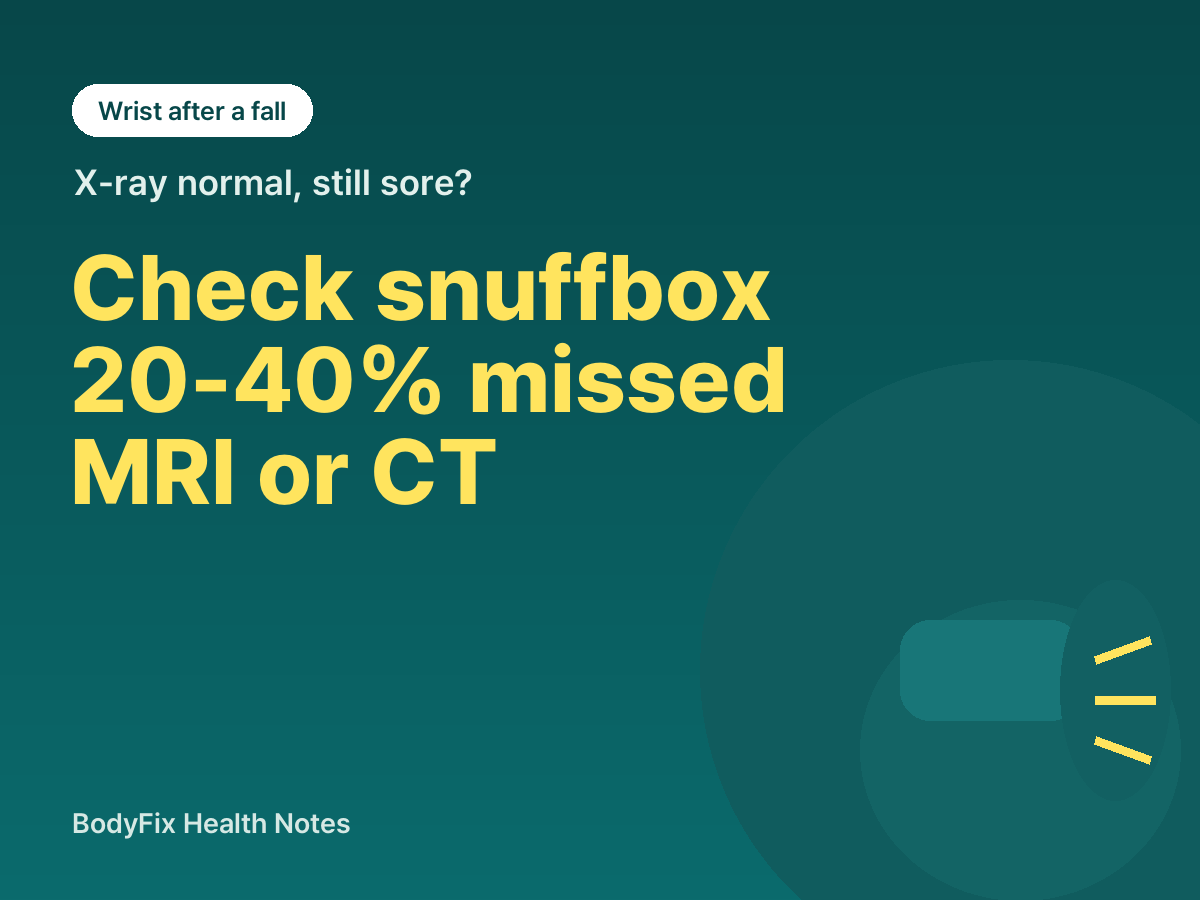
If you fell on an outstretched hand and the hollow at the base of your thumb (the anatomic snuffbox) hurts when pressed — even though the X-ray was reported as normal — a scaphoid fracture has not been ruled out. Wrist X-rays show roughly 70–80% of scaphoid fractures, and only about 60% of non-displaced ones. Persistent tenderness after a normal X-ray means repeat imaging at 2 weeks, or CT/MRI.
This article covers how a scaphoid fracture differs from a wrist sprain, how to examine the snuffbox yourself, what the clinical decision rules actually say, and what treatment and healing times look like. It is general information, not a diagnosis.
Quick answers
- Most likely injury? Only 39% of adults with acute wrist trauma have a fracture; ligament sprain is more common.
- Does a normal X-ray mean it is a sprain? No. Up to 20–40% of scaphoid fractures are invisible on the first film.
- Most useful physical finding? Absence of snuffbox tenderness lowers the odds substantially (negative likelihood ratio 0.15); presence of tenderness is not specific.
- Best next test? MRI is the most accurate for occult fractures; CT is better for displacement and bone detail.
- How long to heal? Around 6 weeks in a cast for a stable waist fracture; 3–6 months for proximal pole fractures, which have a poorer blood supply.
Why is the scaphoid so easy to miss?
The scaphoid sits in the first row of carpal bones, below the base of the thumb. It is the most commonly fractured carpal bone, accounting for roughly 60–70% of carpal fractures. Its blood supply enters at the dorsal ridge near the waist and flows backwards toward the proximal pole, so a fracture through the waist can cut off the proximal fragment. That is why scaphoid fractures heal slowly, and why avascular necrosis is reported in 13–50% of cases, with the highest risk in proximal pole injuries (Kawamura & Chung, 2015).
The clinical picture is deceptively mild. There is often no visible deformity and little bruising — just a dull ache on the thumb side of the wrist, worse when gripping, opening a jar, or pushing up from a chair. Patients frequently describe it as “just a sprain” for days before seeking care.
| Feature | Wrist sprain | Scaphoid fracture |
|---|---|---|
| Where it hurts | Diffuse, whole wrist with movement | One spot in the snuffbox, thumb base |
| Provocation | Stretching or twisting the wrist | Pressing the snuffbox; axial thumb compression |
| First X-ray | No bone injury | Normal in 20–40% of cases |
| Typical course | Improves over 2–6 weeks | Cast 6+ weeks; proximal pole 3–6 months |
| If missed | Stiffness, usually recovers | Nonunion, avascular necrosis, wrist arthritis |

How do you examine the anatomic snuffbox?
Spread the thumb away from the hand. A triangular hollow appears on the back of the wrist between the thumb extensor tendons. Press gently into it, then apply a light axial load along the thumb toward the wrist. Pain on either manoeuvre is “snuffbox tenderness.”
The finding matters most when it is absent. In a meta-analysis of 75 studies of adults with normal emergency-department X-rays, the negative likelihood ratio for absent snuffbox tenderness was 0.15 (Carpenter et al., 2014) — meaning the probability of fracture drops substantially. Present tenderness is far less specific: many sprains hurt in the same spot. Ulnar deviation pain and reduced grip strength add supportive, not decisive, information.

What do the clinical decision rules actually show?
The Amsterdam Wrist Rules were derived and externally validated in 882 adults with acute wrist trauma across five Dutch hospitals. Only 39% had a fracture. The rule — age, sex, wrist swelling, snuffbox swelling, visible deformity, distal radius tenderness, pain on radial deviation, and painful thumb compression — achieved 98% sensitivity but only 21% specificity, with a negative predictive value of 90% (Walenkamp et al., 2015). In other words, it is built to avoid missed fractures, and it accepts a lot of unnecessary X-rays to do so.
A rule built specifically for the scaphoid analysed 893 patients in whom 7.6% had a fracture. Using sex, snuffbox swelling and tenderness, scaphoid tubercle tenderness, painful ulnar deviation and painful axial thumb compression, sensitivity was 97% and specificity 20%; applying it reduced unnecessary immobilisation and imaging by 15% while halving the risk of a missed fracture compared with usual practice (Mallee et al., 2020).
UK NHS patient guidance puts the numbers plainly: X-rays identify 70–80% of scaphoid fractures overall and about 60% of undisplaced ones; among patients referred with a “query scaphoid,” roughly 1 in 20 turns out to have a fracture; and about 10% of confirmed, immobilised fractures still fail to unite (Gloucestershire Hospitals NHS Foundation Trust).
What happens next at the clinic?
With a normal or equivocal first X-ray and ongoing tenderness, there are three usual routes: repeat films at 2 weeks (with a splint in the meantime), CT, or MRI. CT characterises the fracture line and displacement well. MRI is the most accurate test for detecting occult fractures and for identifying alternative causes of pain such as ligament injury or bone bruising (Carpenter et al., 2014). One small randomised study found early MRI cut unnecessary immobilisation, clinic visits and time off work, at a similar median cost to conventional management (Kelson et al., 2016).
Once a fracture is confirmed, treatment depends on location and displacement. A stable waist fracture is usually treated in a cast or splint for at least 6 weeks. Proximal pole fractures take longer — 3–6 months is common — and are more likely to be fixed surgically, as are displaced fractures and injuries in athletes needing an early return. Nonunion is reported in 5–12% overall and, left untreated, can progress to carpal collapse and degenerative arthritis (Kawamura & Chung, 2015).
🚨 Get reviewed promptly if
- The wrist is visibly deformed or swelling is marked
- Snuffbox pressure or axial thumb compression reproduces sharp pain
- The X-ray was normal but pain is unchanged at 1–2 weeks
- Grip strength has clearly dropped, or you cannot turn a key or jar lid
- Fingers are numb or wrist movement is limited
🙂 Reasonable to manage at home if
- There is no snuffbox tenderness and the wrist moves without sharp pain
- Swelling is settling and pain is improving within the first two weeks
- You still avoid heavy gripping and pushing up on the hand, and keep the fingers moving
FAQ
Is it safe to wait two weeks with a normal X-ray?
Waiting is only reasonable as part of a plan, not as a substitute for one. If snuffbox tenderness is present, keep the splint on and book the reassessment — repeat films, CT or MRI. Two weeks is the usual interval because bone resorption can make a hairline fracture visible, but MRI can be done sooner.
How long is a cast needed?
At least 6 weeks for a stable waist fracture, longer for proximal pole injuries. Even when no fracture is confirmed, a splint is often kept while pain persists and then weaned after reassessment. Keep the fingers, elbow and shoulder moving throughout.
Can a scaphoid fracture heal without treatment?
Some undisplaced fractures do heal with immobilisation. Without immobilisation, healing is unlikely, and nonunion can lead to wrist collapse and arthritis over years. That is why an aching thumb-side wrist after a fall deserves follow-up rather than a shrug.
When can I return to sport?
After union is confirmed and pain and swelling have settled, build back gradually. Weight-bearing through the wrist — push-ups, yoga arm balances, racket sports — comes last. Discuss timing with your clinician, especially if you were treated surgically.
Related reading
- Pain on the little-finger side of the wrist: TFCC tears — the other common injury from a fall onto the hand.
- Wrist pain during push-ups: load and alternatives — how to rebuild wrist loading after recovery.
- Carpal tunnel syndrome: night numbness and treatment — if the main symptom is numbness rather than post-injury pain.
Sources
- Carpenter CR, et al. Adult scaphoid fracture. Acad Emerg Med. 2014. PubMed
- Walenkamp MMJG, et al. The Amsterdam wrist rules. BMC Musculoskelet Disord. 2015. PubMed
- Mallee WH, et al. Detecting scaphoid fractures in wrist injury: a clinical decision rule. Arch Orthop Trauma Surg. 2020. PubMed
- Kelson T, et al. Early MRI versus conventional management in occult scaphoid fractures. Emerg Radiol. 2016. PubMed
- Kawamura K, Chung KC. Treatment of scaphoid fractures and nonunions. J Hand Surg Am. 2015. PMC
- Steinmann SP, Adams JE. Scaphoid fractures and nonunions: diagnosis and treatment. J Orthop Sci. 2006. PMC
- Gloucestershire Hospitals NHS Foundation Trust. Suspected scaphoid injury. nhs.uk
Published 2026-11-23 · 7 sources · Last reviewed 2026-11-23
This is general health information, not medical advice. Diagnosis and treatment decisions belong with your clinician.
답글 남기기