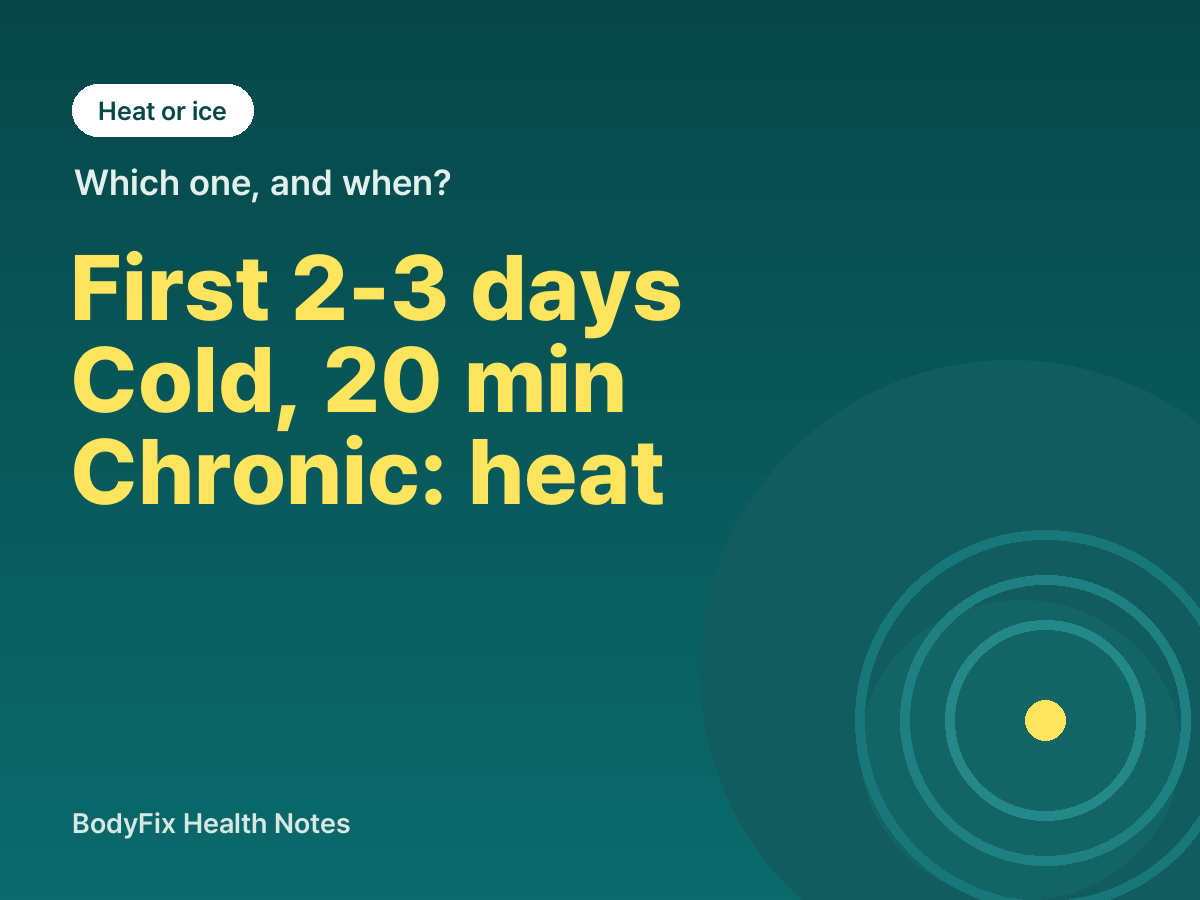
For the first two to three days after an injury, cold is the conventional choice; for pain lasting more than six weeks, heat has the better evidence. The size of the effect is modest either way. A Cochrane review found heat wrap reduced low back pain by about one point on a five-point scale after five days, while the added benefit of ice in acute ankle sprain remains uncertain in randomised trials.
This article separates what the trials actually measured from what clinics routinely advise, gives a scenario-by-scenario table, and sets out the time and temperature limits that keep either treatment from causing harm. It is general information, not a prescription.
Quick answers
- Ice or heat first? Cold for the first 2–3 days after a sprain or strain; heat once the injury is no longer hot and swollen.
- Does ice speed healing? Evidence is weak. It dulls pain briefly; it has not been shown to accelerate recovery.
- Best evidence for heat? Chronic low back pain: heat wrap reduced pain by 1.06 points out of 5 versus placebo after 5 days (two trials, 258 people).
- How long? Ice up to 20 minutes every 2–3 hours, always wrapped. Heat at 40–45 °C for 20–30 minutes.
- Avoid both if skin sensation is reduced — neuropathy, Raynaud’s, after surgery or a nerve block.
What do cold and heat actually do?
Cold narrows blood vessels and slows nerve conduction, which reduces pain and limits early swelling. Heat dilates vessels and relaxes muscle, which helps stiffness and the feeling of a joint that “won’t loosen up.” The two are not interchangeable; they answer different problems.
In the first days after tissue injury, blood flow and inflammatory cells gather at the site, producing swelling. Adding heat then can increase that swelling, which is why the NHS advises avoiding hot baths, heat packs and massage for the first couple of days after a sprain. In chronic pain, the dominant problem is more often muscle guarding and reduced movement than fresh inflammation, and warmth helps people move.
| Situation | Choice | Dose | Caution |
|---|---|---|---|
| Ankle or wrist sprain, first 2–3 days | Cold | 20 min wrapped, every 2–3 h | Never ice directly on skin |
| Muscle soreness 1–3 days after training | Either, briefly | 15–20 min, once or twice daily | Weak evidence; easy movement matters more |
| Low back pain over 6 weeks | Heat | 40–45 °C, 20–30 min, twice daily | Burn risk overnight; avoid on numb skin |
| Stiff neck and shoulders on waking | Heat | 15–20 min, then move gently | If hot and swollen, use cold instead |
| Chronic ankle swelling | Compression and elevation first | Cold 10–15 min as an adjunct | Prolonged cold can increase stiffness |

Where does the evidence actually stand?
Heat for chronic low back pain is the strongest signal. In the Cochrane review of nine trials (1,117 participants), heat wrap therapy reduced pain after five days by a weighted mean difference of 1.06 points on a 0–5 scale compared with oral placebo (95% CI 0.68–1.45; two trials, 258 participants). A heated blanket reduced acute low back pain by 32.2 points on a 0–100 scale immediately after application (90 participants). Adding exercise to heat wrap further improved pain and function (French et al., 2006).
Cold for low back pain has almost no evidence. The same review found only three poor-quality studies and concluded no conclusions could be drawn; comparisons of heat versus cold were conflicting. That is worth knowing, because “ice it” is often said reflexively.
Cold for acute ankle sprain is not clearly effective. A systematic review found only two randomised trials, both at high risk of bias, and the added effect of cryotherapy on swelling, pain and range of motion was uncertain (Miranda et al., 2021). An earlier review of 22 trials in acute soft-tissue injury averaged 3.4 out of 10 on the PEDro quality scale and found only marginal evidence that ice plus exercise was most effective, with no evidence for an optimal mode or duration of cooling (Bleakley et al., 2004).
This is why the clinical message has shifted. The “PEACE & LOVE” framework, proposed by sports rehabilitation researchers, argues for protecting the injury, elevating it, and loading it gently rather than chasing ice and anti-inflammatories — an expert proposal rather than a trial result (Dubois & Esculier, 2020). In practice, ice remains a reasonable way to make the first days bearable; it is not a treatment that accelerates repair.

How to use either one safely
Cold: 20 minutes maximum. Prolonged cooling causes reflex vasodilation and can increase swelling, and skin can be injured. Wrap ice packs or frozen vegetables in a dry towel. Do not use cold on areas with reduced sensation — diabetic neuropathy, Raynaud’s phenomenon, or skin still numb after surgery.
Heat: 40–45 °C for 20–30 minutes. If it feels hot rather than comfortably warm, it is too hot. Never fall asleep on a heating pad; low-temperature burns develop slowly and are common. Avoid heat on a limb that is acutely swollen and hot, on a leg that might have a clot (one-sided swelling, redness, tenderness), and on feet with reduced sensation.
Add movement after either. Ten minutes of gentle range-of-motion work while the tissue is comfortable does more for recovery than the thermal modality itself, and heat makes that movement easier to start.
🚨 When heat or ice is not the answer
- Swelling and pain keep worsening beyond 48 hours
- You cannot bear weight, or the limb looks deformed
- One leg is swollen, red and tender — possible clot
- Fever, spreading redness, or an open wound
- A burn mark appears on skin with reduced sensation
🙂 Reasonable to self-manage if
- Swelling is settling and you can move the area gently
- Pain comes in episodes rather than constant severe pain
- Movement feels a little easier after warming up or cooling down
FAQ
Can I alternate ice and heat?
You can, but keep each block short — 10–15 minutes — and do not exceed about 30 minutes in one session. Alternating is most useful in later rehabilitation when swelling persists; in the first 48 hours, keep cold as the default.
Warmth feels better, so why not use it after an injury?
Comfort and recovery are not the same thing. Heat can feel pleasant while increasing blood flow and swelling in freshly injured tissue. Wait until the swelling has peaked and is coming down.
Does ice actually delay healing?
The evidence does not show that ice delays healing; it shows we lack good evidence that it speeds it up. Used for comfort in short blocks, it is low risk for most people.
What about heat rubs or patches?
Do not stack them with a heat pack — skin irritation and burns become more likely. If a patch leaves redness that lasts, stop using it on that area.
Related reading
- Ankle pain after football: sprain or fracture? — what to do in the first days after a roll.
- Low back pain: rest or keep moving? — why activity outperforms passive treatment.
- Shin splints in runners — distinguishing load-related pain from a stress fracture.
Sources
- French SD, Cameron M, Walker BF, Reggars JW, Esterman AJ. Superficial heat or cold for low back pain. Cochrane Database Syst Rev. 2006. PubMed
- Miranda JP, et al. Effectiveness of cryotherapy on pain, swelling, range of motion, function and recurrence in acute ankle sprain. Phys Ther Sport. 2021. PubMed
- Bleakley C, McDonough S, MacAuley D. The use of ice in the treatment of acute soft-tissue injury. Am J Sports Med. 2004. PubMed
- Dubois B, Esculier JF. Soft-tissue injuries simply need PEACE and LOVE. Br J Sports Med. 2020. PubMed
- NHS. Sprains and strains. nhs.uk
- Cambridge University Hospitals NHS Foundation Trust. Scaphoid fractures (ice timing guidance). nhs.uk
Published 2026-11-23 · 6 sources · Last reviewed 2026-11-23
This is general health information, not medical advice. Diagnosis and treatment decisions belong with your clinician.
답글 남기기